Categories
Uncategorized

Application of Habit Formation and Dual Process Theory to my running experience

In between posting ‘A bit more background, SMART goals and small victories’ and ‘Attentional strategies and entering flow on the final long run before the Anglesey Half Marathon’, my training had not gone exactly to plan.

While the rest of the group seemed to be hitting milestones, the only thing I seemed to be hitting was a brick wall. Within the space of well over a week, I’d not managed to get out for a run due to horrendous cramps that had me doubled over in pain for hours on end (a slight exaggeration, but you get the point!).

I took some time to reflect on the things I had achieved in that time, and I decided that dwelling on the negative was not the best way to move forward. Following a lecture with Dr Rhi Willmot, I knew that I had to start thinking about establishing new habits that would make getting out for a run a little easier.

Lally and Gardner (2013) define habits as ‘automatic behavioural responses to environmental cues’ that develop through repeating a certain behaviour within a certain context. Put more simply, habits are a result of routine behaviours that follow cues and result in rewards. The use of rewards is essential to habit formation, as they act as positive reinforcers which increase the likelihood of a behaviour being repeated.

According to many sources, forming a new habit takes approximately three weeks, or 21 days, to establish a habit (Dean, 2013) – seems easy enough!

A habit can be broken down into three separate parts: cue, routine and reward. The cue is the stimulus that pre-empts the routine behaviour, which is the habit itself. The routine behaviour is then followed up immediately by a reward, which reinforces the routine behaviour and increases the likelihood of repetition (Judah, Gardner & Aunger, 2013).

At this point in time, I was still trying to get into the habit of going for a run. I had to establish what would work as a cue that would get me out for my runs, and then ensure that I had a nice reward to look forward to when I got back from my run.

The cue for me to go for a run was simple: I would leave my running gear out on a chair in my room the night before so it was all ready for me to change into in the morning. The routine would follow: I’d go out for my run. As soon as I got back home, I would reward myself by watching an episode of a TV show (and at the time, it happened to be Game of Thrones!).
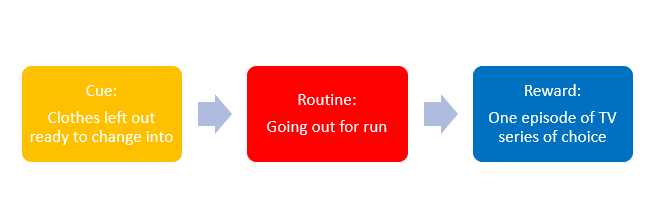
A simple flow diagram created by myself showing the cue, routine and reward for my habitual behaviour of going for a run

While the cue-routine-reward structure provides a relatively simple framework for habit formation, its implementation requires a substantial amount of self-efficacy and motivation, which at the time, I did not seem to have.

Self-efficacy was first introduced by Bandura (1982), who defined it as one’s belief or judgement of one’s ability to complete a certain task.

In the initial weeks of training for the marathon, my running was not progressing as smoothly as I wanted it to and this was possibly due to the fact that I did not hold the same belief I could run several miles that I do now. A lot of the time, I would fall at the first hurdle of actually getting out the door. I didn’t enjoy running as there was very little that seemed enjoyable about it, meaning that there I didn’t have any reinforcers for actually going out for a run. Consequently, I had very little motivation to go out running.

Although the running itself can still be quite painful and difficult at times for me, when I get back after a run, I tend to experience that wonderful ‘post-run high’ resulting from the surge of serotonin that comes after doing exercise (Chaouloff, 1989). This in itself has become rewarding for me and has been beneficial in increasing my self-efficacy towards running.

However, Stanovich and West’s (2000) Dual Process Theory offers one possible explanation as to why I might have been more inclined to stay inside and less inclined to go for a run.

Their theory posits that any thoughts that arise can be processed by one of two systems. The ‘hot’ system (System 1) is described as being inflexible, automatic and requiring very little brain power meaning it often deals with more unconscious notions. The ‘cold’ system (System 2) is described as being more rule-based, analytical and requiring a greater amount of brain power, meaning it deals with more conscious notions.

So, when I’ve thought about going for a run, there has been a battle between the two systems in my mind, and throughout the past week it is clear that the ‘hot’ system has prevailed over the ‘cold’ system.

Staying inside has provided me with the instant gratification on which the ‘hot’ system thrives; the positive feeling generated by warmth, pain relief and food (and binge-watching Game of Thrones…eeek!) which has triumphed over the weaker ‘cold’ system that has urged delay of the gratifying positive feelings until I have completed a run.

Had I not been suffering with cramps, there may have been a slightly increased likelihood of the ‘cold’ system beating the ‘hot’ system.

Receiving positive encouragement and hearing reassuring information from others on the module about their own running struggles helped put my own into perspective. The positive encouragement has become a form of reinforcement that has spurred me on to going out running more, and this has, in turn, resulted in increased use of the ‘cold’ system.

“Motivation is what gets you started. Habit is what keeps you going.”

Jim Ryun

References

Bandura, A. (1982). Self-efficacy mechanism in human agency. American Psychologist, 37(2), 122-147. doi:10.1037/0003-066X.37.2.122.

Chaouloff, F. (1989). Physical exercise and brain monoamines: a review. Acta Physiologica Scandinavica, 137(1), 1-13. doi:10.1111/j.1748-1716.1989.tb08715.x

Dean, J. (2013). Making habits, breaking habits. Oneworld Publications.

Judah, G., Gardner, B., & Aunger, R. (2013). Forming a flossing habit: An exploratory study of the psychological determinants of habit formation. British Journal of Health Psychology, 18(2), 338-353. doi:10.1111/j.2044-8287.2012.02086.x

Lally, P., & Gardner, B. (2013). Promoting habit formation. Health Psychology Review, 7(1), S137-S158. doi:10.1080/17437199.2011.603640

Stanovich, K., & West, R. (2000). Individual differences in reasoning: Implications for the rationality debate? Behavioural and Brain Sciences, 23(5), 645-726. doi:10.1017/S0140525X00003435
Categories
Uncategorized

A month of inactivity, dealing with self-criticism, and a change of plan

Unless you have been living under a rock for the past few weeks, you are probably aware that we are currently in the midst of a global pandemic: Covid-19, or Coronavirus as it is also known.

This has undoubtedly caused a great deal of disruption all over the world, but for me it has resulted in the postponement of both my upcoming running events (Liverpool RnR Marathon: 24/25th Oct; Reading Half Marathon: 1st Nov).

As a result of the rescheduling of these events, both of which I was really looking forward to given my recent positive experience at the Anglesey Half Marathon, I regret to say that my motivation to get out and run has declined massively. Prematurely moving back home, due to the suspension of all face-to-face teaching till the end of my degree, has left me feeling very demotivated to do virtually anything, including getting out for runs.

While I know that getting into some sort of routine in times of uncertainty is likely to have a positive effect on one’s well-being (Ludwig, 1997), I have found it extremely difficult to do so.

As the above demonstrates, I have always been hard on myself. Whilst I always try and come across as a person who is accepting of their faults and failures, I am a perfectionist at heart and with that comes the *toxic* trait of being very self-critical.

I know that I am not alone in this; according to research by Taranis and Meyer (2010), female athletes with high self-criticism were more likely to be perfectionistic in their personal standards. However, Taranis and Meyer’s (2010) research also revealed that those athletes who were highly self-critical also felt more compelled to exercise, which applies to me somewhat, as when I criticize myself, I sometimes do feel the urge to get out for a run more than when I am perhaps not so self-critical. This would suggest that a certain amount of self-criticism is a good thing!

Self-criticism is a negative evaluation of oneself (Gilbert, Clarke, Hempel, Miles & Irons, 2004), whereas self-compassion is an individual’s feelings of love, kindness and understanding that they would typically show to others towards themselves (Barnard and Curry, 2011). It has been found that increased self-compassion can reduce self-criticism, as shown amongst a group of female varsity athletes (Mosewich, Crocker, Kowalski and DeLongis, 2013).

Upon reflection of my feelings towards myself and my running over the past few weeks, it is clear that I am very self-critical whilst I am actually out running. I recently ran a distance of 5K after taking a bit of time off from running. My self-critical feelings towards my lack of exercise at the time were partly responsible for making me get out for the run – ‘good’ self-criticism; but while I was out running I continued to be very self-critical about the speed at which I was running and how difficult I was finding it – ‘bad’ self-criticism.

My brain kept telling me, “you should find this easy, you just ran the Anglesey Half Marathon for god’s sake!”, neglecting the fact that I’d not been out for a run in weeks and, as a result of not being particularly active, my stamina would’ve naturally decreased.

Being so critical of myself is something I very much want to change, and I will attempt to do this by increasing my self-compassion.

One way I will achieve this is by incorporating meditation into my daily routine. A study by Albertson, Neff and Dill-Shackleford (2014) found that a 3-week meditation intervention was highly beneficial in reducing body dissatisfaction and increasing self-compassion and body appreciation within a group of women.

The intervention in Albertson, Neff and Dill-Shackleford’s (2014) study was delivered as three different 20-minute podcasts that participants were instructed to listen to once a day for a week. Each week focused on a different aspect of self-compassion, starting with compassion itself, followed by affection and ending with kindness.

The authors of the study *very kindly* included a link to the website where these podcasts can be found so I will, in a sense, attempt to replicate the study by listening to the podcasts used within it (and I’ve included the link in case you want to have a go too!).

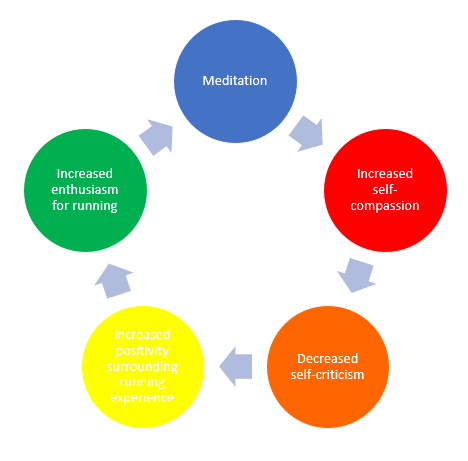
Meditation will be beneficial as it will help me increase my self-compassion which will decrease how much I criticize myself. This will, in turn, help me develop a more positive and reflective mindset making the experience of running more enjoyable for me, and will result in me feeling more enthusiastic about going for a run. In general, when I am in a positive mood I tend to be much more productive and willing to get out and do things that I find challenging, like running. Therefore, meditation will likely help me maintain a sense of positivity for a longer period of time and this will increase my enthusiasm to keep pursuing it.

A flow diagram created by myself providing a visualisation of the knock-on effects meditation will have on own unique running experience

Additional research by Neff, Kilpatrick and Rude (2006) across two separate studies demonstrated that self-compassion was useful in terms of reducing anxiety in the face of ego threats and that increased feelings of self-compassion were positively associated with increased wellbeing over a 1-month period.

Therefore, being self-compassionate is incredibly important to me if I am intent on keeping up with my running and increasing my general wellbeing – which I am!

A little over a month ago, PM Boris Johnson announced a nationwide lockdown, with the hopes of limiting the spread of the virus. Everyone was told to stay at home, only being allowed to leave for work if it was absolutely essential. The government also permitted people to leave their homes for one hour a day for exercise purposes, but they must do this either alone or with other people that they live with.

With those restrictions in place, it was clear I wouldn’t be running a marathon anytime soon, but that was a good thing, apparently. According to an article by Jane McGuire I saw recently on Runner’s World, given the current situation, people shouldn’t be going out and running long distances, as it takes its toll on one’s immune system. (And now, more than ever, we need our immune systems to be working at their optimum!)

This is fairly common knowledge amongst runners, and several pieces of research have provided support for this claim. In their paper, Fitzgerald (1988) discussed how Olympic athletes who undergo rigorous training put themselves at a higher level of susceptibility to infection as they enter a state of immunodeficiency. Marathon running, and long-distance running in general are considered to be very rigorous forms of exercise (Williams, 2008), therefore this research is highly applicable to marathon/long-distance runners, like myself.

Now that the date for the marathon has been pushed back, it means that I have a lot more time to focus on breaking down the ultimate goal of running it into several smaller goals.

Since starting the module, one thing I have consistently wanted to improve is my pace/timing. I definitely don’t see myself becoming the next Russell Bentley anytime soon, however I would like to see a decrease in the time it takes me to run a certain distance, for example: 5K, as this is a very clear way of seeing the progress I make.

By working on more short-term goals, it makes the slightly larger long-term goals more easy to attain. As Bovend’Eerdt, Botell and Wade (2009) described in Step 3 of their flowchart for writing SMART goals, it is important to scale the initial goal, which in my case would be running the Liverpool Marathon, by adding sub-goals that are more easily achieved.

Of course, Bovend’Eerdt, Botell and Wade’s (2009) guide was designed for use within a clinical rehabilitation setting, however, having utilised the principles to generate my own SMART goals, I believe I have demonstrated that the basic principles are applicable to goal-setting of any kind.

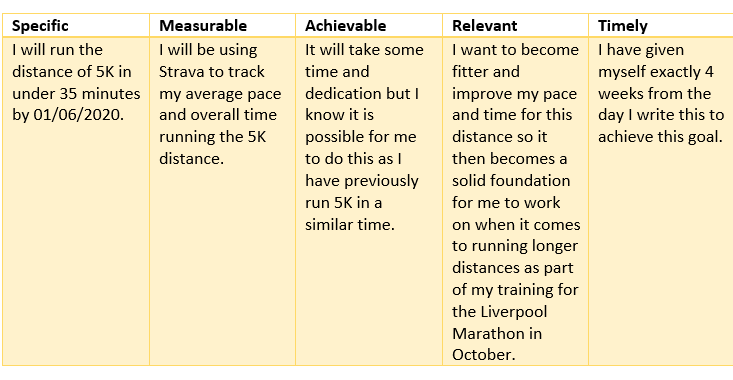
So, for now, I am not going to be focusing on running long distances; my main goal over the next few weeks will be to work on getting my 5K time down. At the moment, it is around the 40-minute mark, but my PR (according to Strava) is roughly 37 minutes.

I think this calls for yet another SMART goal:

The SMART breakdown of my goal to run a distance of 5K in under 35 minutes by 13/05/20

While I have been unable to achieve my previous SMART goal of running the Reading Half Marathon in under 3 hours, the new goal I have set myself will be of great benefit when I eventually come to running 13.1 miles in the future.

The last couple of weeks have been difficult for me, to say the least, but I am determined to get back to my running now that I have a more positive outlook to work on implementing, and a more achievable short-term goal to work on for the time being.

“You are never too old to set another goal or to dream a new dream.”

C. S. Lewis

References

Albertson, E., Neff, K., & Dill-Shackleford, K. (2014). Self-compassion and body dissatisfaction in women: A randomized controlled trial of a brief meditation intervention. Mindfulness, 6, 444-454. doi:10.1007/s12671-014-0277-3

Barnard, L., & Curry, J. (2011). Self-compassion: Conceptualizations, correlates & interventions. Review of General Psychology, 15(4), 289-303. doi:10.1037/a0025754

Bovend’Eerdt, T., Botell, R., & Wade, D. (2009). Writing SMART rehabilitation goals and achieving goal attainment scaling: a practical guide. Clinical Rehabilitation, 23(4), 352-361. doi:10.1177/0269215508101741

Fitzgerald, L. (1988). Exercise and the immune system. Immunology Today, 9(11), 337-339. doi:10.1016/0167-5699(88)91332-1

Gilbert, P., Clarke, M., Hempel, S., Miles, J., & Irons, C. (2004). Criticizing and reassuring onself: An exploration of forms, styles and reasons in female students. British Journal of Clinical Psychology, 43(1), 31-50. doi:10.1348/014466504772812959

Ludwig, F. (1997). How routine facilitates wellbeing in older women. Occupational Therapy International, 4(3), 215-230. doi:10.1002/oti.57

Mosewich, A., Crocker, P., Kowalski, K., & DeLongis, A. (2013). Applying self-compassion in sport: An intervention with women athletes. Journal of Sport and Exercise Psychology, 35(5), 514-524. doi:10.1123/jsep.35.5.514

Taranis, L., & Meyer, C. (2010). Perfectionism and compulsive exercise among female exercisers: High personal standards or self-criticism? Personality and Individual Differences, 49(1), 3-7. doi:10.1016/j.paid.2010.02.024

Williams, P. (2008). Vigorous exercise, fitness and incident hypertension, high cholesterol, and diabetes. Med Sci Sport Exerc, 40(6), 998-1006. doi:10.1249/MSS.0b013e31816722a9

Categories
Uncategorized

Race Reflection: Anglesey Half Marathon

In my last blog, I spoke a lot about the final long run I went on before the Anglesey Half Marathon. I’m about to let you in on a little secret… it was also the last run I went on before the race (oops!). So, in terms of physical preparation in the week before, I did very little. But I don’t plan on dwelling on that too much, it is something I’ve already learnt from, and believe me when I tell you, I’ve paid the price for my mistake!

Without further ado, I believe I promised a low-down of what happened on the day of the race:

6:30am – waking up – I am NOT a morning person, so waking up early doesn’t usually come easily to me, however the nerves drove me out of bed faster than the Roadrunner whizzing past Wile E. Coyote on the Looney Tunes!

7:00am – breakfast – I opted for a breakfast of two Weetabix and a coffee (although my choice of beverage would very soon become mistake numero dos!)

7:45am – time to leave – I triple checked my bag to make sure I had everything I needed (race number, phone, arm strap, warm clothes for afterwards – check, check, check and check!)

8:15am – arriving at the start line – it was around this time that I realised my decision to have a coffee so close to the start of the race was a big mistake – I have never needed to go to the loo so many times within such a short period in my life! As crowds continued to gather, my nerves began to increase.

8:45am – getting in position – people were beginning to make their way over to the official start line – it was at this point that my housemate and I met some fellow ‘Born to Run-ers’ – the camaraderie and support was definitely reassuring in the final few minutes before we set off

9:00am – GO! – the ‘3…2…1…’ countdown had ended and we were off!

In those first few minutes, I went through several emotions, and at one point was close to tears – I didn’t think I could do it – the prospect of running for the next few hours terrified me – I’d never run 13.1 miles before in my life!

From this point onwards, the concept of time became irrelevant to me, I had no set time goal in mind (apart from making the cut off at the 10-mile mark, around 11:15am). Luckily, I managed to find a running buddy from the module and we kept relatively the same pace for several miles, chatting about how we’d spent our reading week.

This meant that I was using the dissociative attentional strategy instead of the associative that I’d originally planned to use, which I discussed in my last post. Talking to my newfound running buddy helped distract me from wondering how far we had run and made those first few miles a great deal easier.

As we approached Beaumaris, running down what we came to know as our worst nightmare (AKA: Allt Goch Bach), we began to see the front-runners making their return, with many of them telling us to “enjoy the downhill!”. This not-so-helpful remark clarified the realisation that we would have to run (and I use the word “run” very, very loosely here) back up this monstrosity.

With that cheery thought in mind, we pressed on through Beaumaris, passing more and more runners and exchanging several words of encouragement. I must admit, one thing I do enjoy about being in a race is how supportive everyone is, and although you don’t have a clue who they are, you find yourself wishing them well, and in turn they do the same.

There is something about the experience of being in a race that makes it vastly different to a normal individual training run. Whilst running in the half marathon, I found myself being able to keep going for longer which indicated to me that I was performing better than I usually would on a training run.

This phenomenon of increased performance during a race is not only common sense, it is also well-documented in the literature:

A study by Tomazini, Pasqua, Damasceno, Silva-Cavalcante, de Oliveira, Lima-Silva and Bertuzzi (2015) found that running in a race gave rise to changes in the performance of recreational runners compared to running alone. Their findings showed that the runners’ overall performance was better in the race condition compared to the individual condition.

However, Tomazini et al’s (2015) research only looked at runner’s completing a 3km race, so the extent to which their findings can be applied to a half marathon race is limited due to the fact that it is, of course, 7 times the distance.

That being said, back in October 2019, I completed the Bangor 10k (my first ever race) and to date, the time I ran that distance in is still my PB!

As we came out the other side of Beaumaris, I gradually ran ahead of my partner, and when I kept looking back to check on them, they seemed to be getting further and further away. When I turned a corner and could no longer see anyone behind me, I realised that from this point onwards I would be going it alone.

My goal remained unchanged: I had to make the cut-off so I could keep going and finish the race, otherwise I’d feel like a complete failure.

At this point, I knew we had to be approaching the halfway mark. The route was due to loop back round at some point, but it kept taking me up and up into the countryside, and it felt like a lifetime had passed by the time I eventually crossed the chip tracker at the 10K mark and the road began to bend back round in the direction of Beaumaris.

Slowly plodding along, I noticed another ‘Born to Run-er’ up ahead and decided to quicken my pace slightly in order to catch up to them. We managed to stick with each other for a little while and, in this time, I came up with a positive thought that would eventually become the only thing keeping me going when I found myself alone again slightly later on.

Being one of the slowest runners in a group of people actually has a perk: the longer you take to finish a race, the more people there are to cheer you on at the end (provided people hang around afterwards until the final person crosses the finish line, which quite a few tend to do). I knew this would be the case for me, as several friends were also taking part in the race, and we’d already made plans to go for a meal in Menai Bridge straight after finishing the race.

The run back into Beaumaris was probably one of the most physically challenging parts of the race as the wind was very strongly against me. It was also at this point that the race began to get very psychologically challenging.

It was then that I began to visualise myself sprinting across the finish line, as all my friends looked and cheered me on.

Research conducted by Samson, Simpson, Kamphoff and Langlier (2018) on the thought processes of long distance runners revealed that many engaged in visualisation as a strategy to enable them to maintain their pace.

Use of the ‘think-aloud’ technique, where the runners’ were asked to verbalise their thoughts during a long-distance run, enabled the researchers to measure runners’ thought processes in real time. This was done by giving each of the runners’ a microphone and recording device to take with them and speak into whilst they were out on their run.

Although Samson, Simpson, Kamphoff and Langlier’s (2018) research provided a useful insight into the different techniques runners’ use for managing their pace, the ecological validity of their study can be questioned, as it is unlikely that I would verbalise my thoughts whilst out on a run in public, as I may get some odd looks from strangers.

In terms of applying this to my own experience, while I didn’t use visualisation to maintain my pace as such, it definitely made me speed up in order to see it unfold in reality.

Therefore, when it comes to running the marathon in May, using visualisation will be crucial for me to keep pushing on in those final few miles.

If you had told me a year ago that I would complete the Anglesey Half Marathon, I would never have believed you! While the course was incredibly tough, and the pain unbearable, I did it (GO ME!).

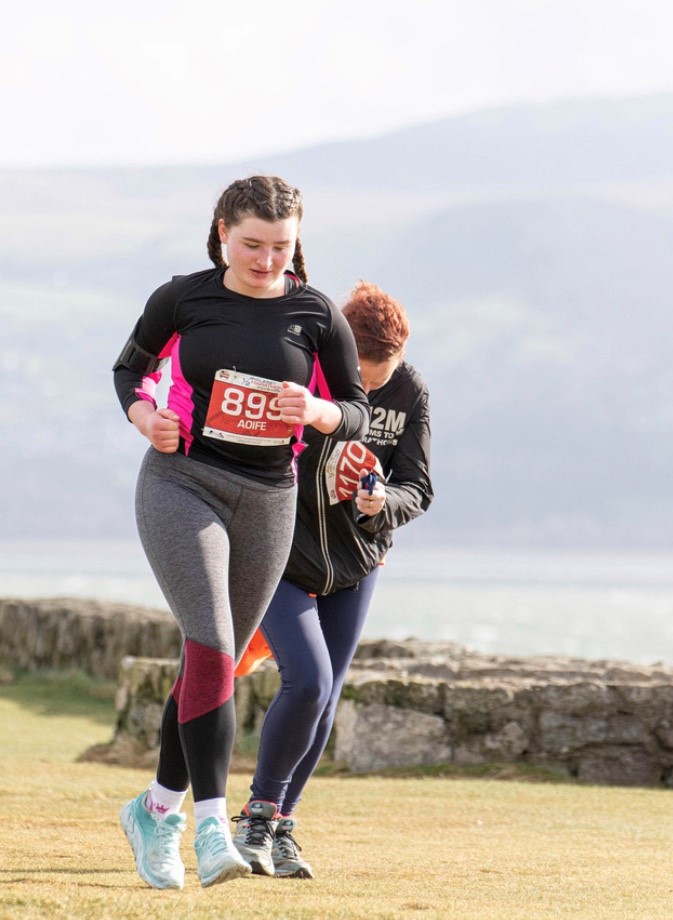
A picture of me, taken by the official race photographer, Mel Parry, on my way along the Beaumaris seafront – the toughest part of the race, as mentioned above.

Thanks to modern technology, there is recorded footage of the moment my visualisation became a reality (skip to 2:56:24).

The satisfying post-race high left me with a hunger to improve. In a moment of impulsivity, along with some encouragement from friends, I signed up for the Reading Half Marathon on 5th April.

This is likely to be a very different experience as I will be running much closer to home, meaning that my family and boyfriend will be able to come and watch me run for the first time. In addition, the route is meant to be very fast and flat, so I am looking to see an improvement upon my Anglesey time, which will hopefully provide a much-needed confidence boost to spur me on in my training and maintain the sense of enthusiasm that will enable me to keep up my running to the end of the module and beyond.

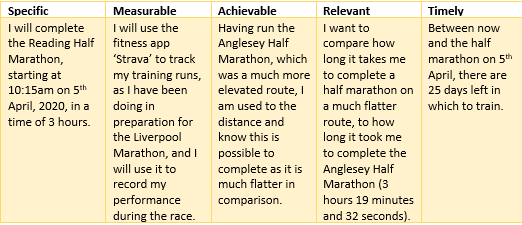
With all this considered, time for another SMART goal:

The SMART breakdown of my goal to run the Reading Half Marathon in 3 hours.

“Run when you can, walk if you have to, crawl if you must; just never give up.”

Dean Karnazes

References

Masters, K. S., & Ogles, B. M. (1998). Associative and dissociative cognitive strategies in exercise and running: 20 years later, what do we know?. The Sport Psychologist, 12(3), 253-270.

Samson, A., Simpson, D., Kamphoff, C., & Langlier, A. (2017). Think aloud: An examination of distance runners’ thought processes. International Journal of Sport and Exercise Psychology, 15(2), 176-189. https://doi.org/10.1080/1612197X.2015.1069877

Tomazini, F., Pasqua, L. A., Damasceno, M. V., Silva-Cavalcante, M. D., de Oliveira, F. R., Lima-Silva, A. E., & Bertuzzi, R. (2015). Head-to-head running race simulation alters pacing strategy, performance, and mood state. Physiology & behavior, 149, 39-44. https://doi.org/10.1016/j.physbeh.2015.05.021

Categories
Uncategorized

Attentional strategies and entering flow on the final long run before the Anglesey Half Marathon

In the weeks leading up to the Anglesey Half Marathon, I experienced a lot of self-doubt, lacking a great deal of confidence in my ability to run that distance (13.1 MILES – TERRIFYING!). This was partly due to feeling like I was lagging significantly behind everyone else. I’d made peace with the fact that I was one of the slowest in the group, it was always going to be a place someone had to fill, but I did secretly hope it wouldn’t be me.

The last lecture we had before the half marathon involved a brief discussion regarding tactics and preparation for the big day. We briefly touched on the topic of how to overcome when running starts to get painful and mentally draining, and this brought us onto the topic of where to focus our attention in these difficult times.

Upon researching this a bit more, I came across two different kinds of attentional strategies that can be adopted whilst you’re running: associative and dissociative.

In particular, we talked about two different kinds of attentional strategies that can be adopted whilst you’re running: associative and dissociative. According to Masters and Ogles (1998) the associative technique involves focusing your attention intrinsically on what you are actually doing. For example, when I’m running, I could be focusing on my running form, bodily functions such as heart rate or muscle tension, or on my breathing.

On the flip side, Masters and Ogles suggest that the dissociative technique puts more emphasis on focusing on extrinsic factors by providing a distraction or tuning out from what you are doing. Once again, when I’m running, I could be listening to music in order to distract myself from any discomfort I might be feeling as a result of putting my body under strain.

Seemingly, as mentioned in Connolly and Janelle’s (2003) paper, contrary to their predictions, Morgan and Pollock (1977) found that elite marathon runners reported use of the associative technique more than the dissociative.

In addition, according to research by Smith, Gill, Crews, Hopewell and Morgan (1995) experienced distance runners who were measured on both their use of associative or dissociative attention and their running economy (which to the best of my knowledge and understanding is the efficiency at which your body converts oxygen into movement, so the less oxygen you use the more economical you are), and were found not to differ on their use of associative and dissociative attentional style based on their running economy, but the more economical runners reported decreased use of dissociation and increased use of relaxation than the less economical runners.

While a large portion of the research is based on the experiences of elite or experienced distance runners, I think it is safe to say that this technique can be applied to runners of all abilities and therefore will be greatly beneficial for me, a beginner, during my training and when I am running the marathon in May.

Later in the week, I decided to apply the associative attentional technique method to my final LSR before the race. Previously, I would’ve always opted for the dissociative option of listening to music, but in recent times, the need for it has decreased, as I’ve started running with others and also because UK Athletics race regulations stipulate that using normal headphones is not permitted.

This method actually proved to be quite successful as I managed to run consistently without stopping to walk for my longest distance yet. This was also the run where I hit my biggest distance so far (9.3 miles…eeek!) – a HUGE milestone!

If this run taught me anything, it was that all it really boils down to is mind over matter. With the right mental state, you can accomplish anything, and for me this could not be more prevalent with my running.

On the day I set out for my longest LSR, I had one goal in mind: to reach 9 miles. I was not concerned with how long it took me, I just wanted to prove to myself I could do it. Upon adopting that mindset, I found I was able to keep going for much longer than I’d previously run.

Many athletes would describe my experience as being ‘in the zone’, but in more psychological terms, I was channelling the mental state of ‘flow’.

Flow is one of the 8 mental states described by Nakamura and Csikszentmihalyi (2009) , and it can be described as a subjective state involving intense concentration on the present moment, complete loss of self-consciousness and a merging of action and awareness.

Image taken from: https://en.wikipedia.org/wiki/Flow_(psychology)

A state of flow is most likely to arise when performing an active task, rather than passive. There are three conditions which must be met in order to successfully enter flow state:

  1. There must be involvement within a task that has clear goals and progress which add to structure and direction
  2. The task must involve direct and instantaneous feedback, which help an individual navigate changing demands and allow them to alter their performance to sustain the state of flow
  3. The individual’s perceived skills and their perception of the challenges of the task must be balanced and they must have self-belief in their ability to complete the task

I realised I had entered this state when I found running at a consistent pace and thinking “this is easy!” (for once! – most of the time I’ve found myself in the red zone on the diagram above, feeling incredibly anxious about being able to run long distances ). As previously mentioned, my goal was clear: run for 9 miles, and I was seeing progress in my ability to run for a much longer period than I ever had before.

The ease at which I continued to run at my set pace provided the immediate feedback I needed to reassure myself that I could keep going and maintain the flow state.

The more I kept running, the more achievable reaching 9 miles seemed, and the more I felt I could do it, thus reflecting the third and final condition of balance between my perceived ability and the perceived challenge of the distance I needed to ensure I stayed within flow state.

Flow state as a concept in relation to performance in sport was investigated by Schüler and Brunner (2009). They attempted to explore the relationship between experiences of flow and performance using a marathon as their example. The results from their research indicated that while experiencing flow during a marathon was correlated with running motivation in the future, it was actually pre-race training experiences of flow that fostered higher performance amongst the individuals they analysed.

So, based on Schüler and Brunner’s findings, my experience of flow in my final long run before the race is likely to play some role in assisting my performance on the day. However, the amount to which entering flow state during my training runs relates to my performance is still up for debate, as there are likely to be many other factors at play, some of which are yet to be discovered.

To summarise, I have evaluated the use of the associative technique in relation to my own running and I have described how I successfully managed to maintain flow state whilst out on a long training run. Both of these concepts will be of great use when running the Anglesey Half Marathon, and indeed the Liverpool Marathon in the coming weeks and months.

In my next blog post I will be giving the low-down on what went on in the final few days before and the day of the Anglesey Half Marathon, so be sure to keep an eye out for that!

Do not go with the flow. Be the flow.

Elif Safak

References

Masters, K. S., & Ogles, B. M. (1998). Associative and dissociative cognitive strategies in exercise and running: 20 years later, what do we know?. The Sport Psychologist, 12(3), 253-270.

Morgan, W. P., & Pollock, M. L. (1977) as cited and referenced in: Connolly, C., & Janelle, C. (2003). Attentional strategies in rowing: Performance, perceived exertion, and gender considerations. Journal of Applied Sport Psychology, 15(3), 195-212. DOI: 10.1080/10413200305387

Nakamura, J., & Csikszentmihalyi, M. (2009). Flow theory and research. Handbook of positive psychology, 195-206.

Schüler, J., & Brunner, S. (2009). The rewarding effect of flow experience on performance in a marathon race. Psychology of Sport and Exercise, 10(1), 168-174. https://doi.org/10.1016/j.psychsport.2008.07.001

Smith, A. L., Gill, D. L., Crews, D. J., Hopewell, R., & Morgan, D. W. (1995). Attentional strategy use by experienced distance runners: Physiological and psychological effects. Research quarterly for exercise and sport, 66(2), 142-150. https://doi.org/10.1080/02701367.1995.10762221

Categories
Uncategorized

Brick walls, progress reflection and habit formation

Since my last post, my marathon (and half marathon) training has not exactly gone to plan. While the rest of the group seem to be hitting milestones, the only thing I seem to be hitting is a brick wall. In the space of just over a week, I have managed to get out for a grand total of zero runs outside due to cramps that have left me doubled over in pain for hours on end (a slight exaggeration, but you get the point!).

Now, I could go on and on making excuses about how and why cramps have prevented me from running, but rather than wallow in self-pity, I have decided to focus on the positives (what I have achieved rather than what I haven’t):

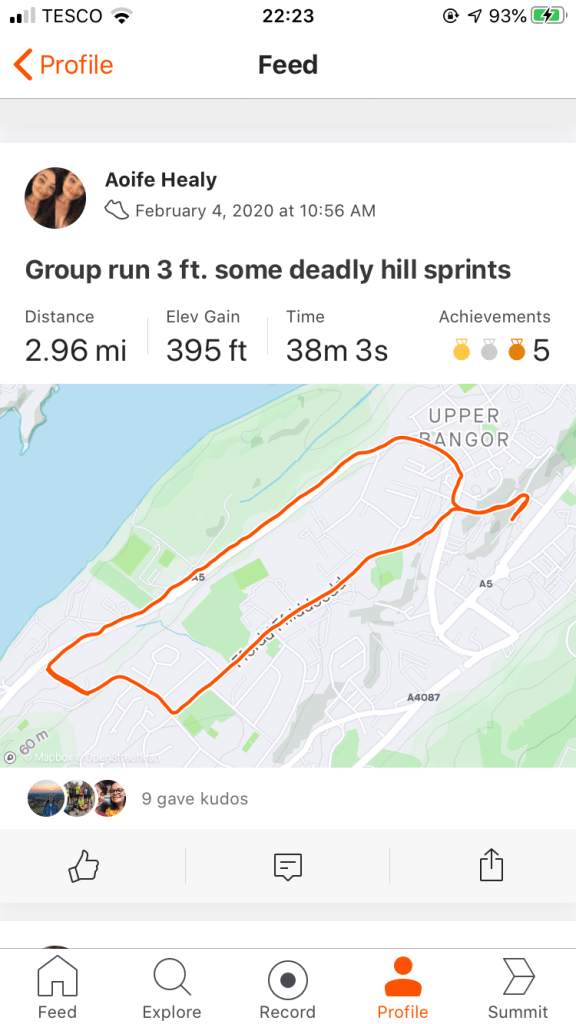
  • 04/02/20 – Group Run 3 – in which I attempted hill sprints for the very first time (I died)
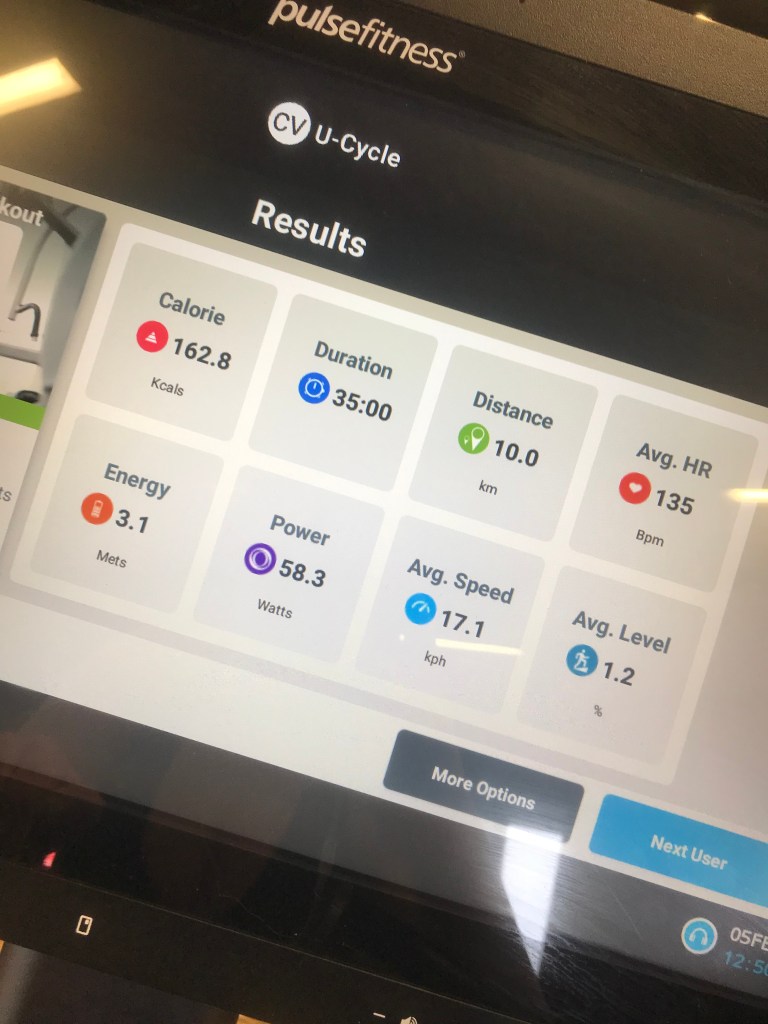
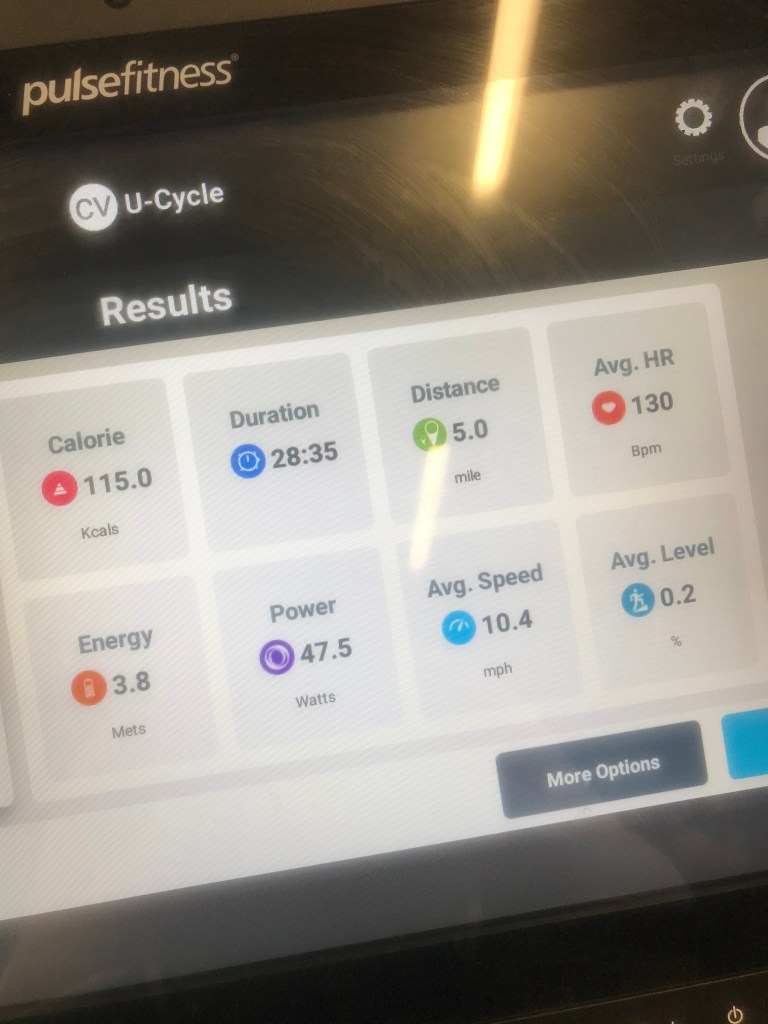
  • 05/02/20 – Cross-training session – 10k on the exercise bike followed by some strength/conditioning exercises
  • 07/02/20 – Cross-training session – uphill walking and some stretching to relieve the cramps
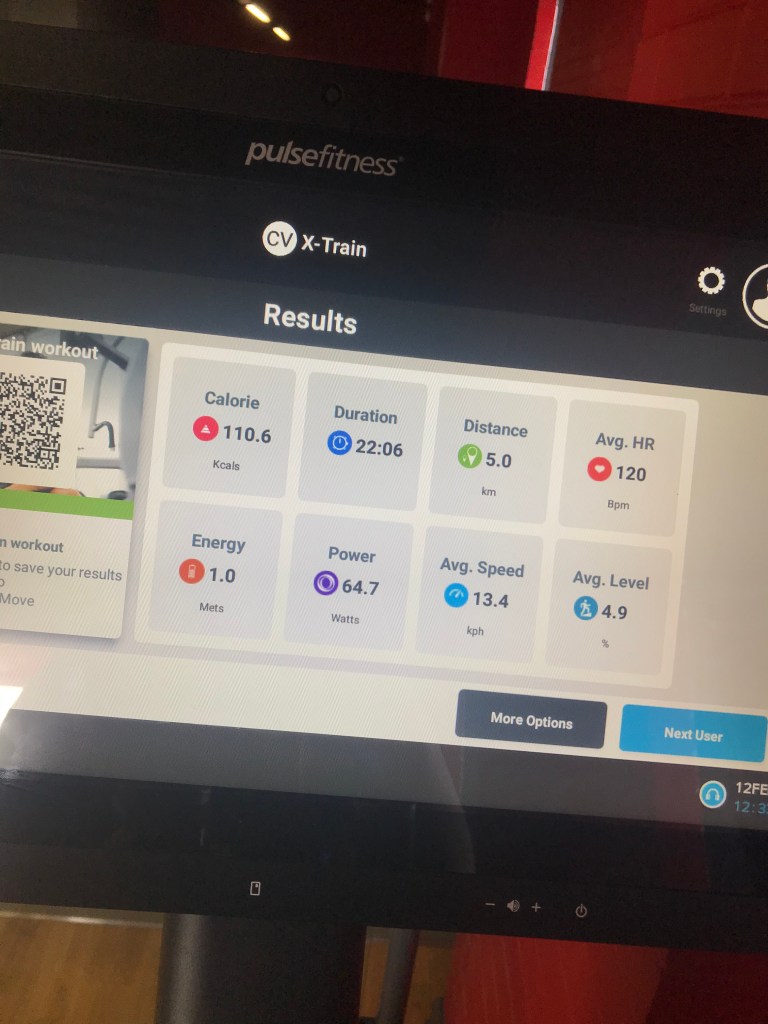
  • 12/02/20 – Cross-training session – 5k on the elliptical
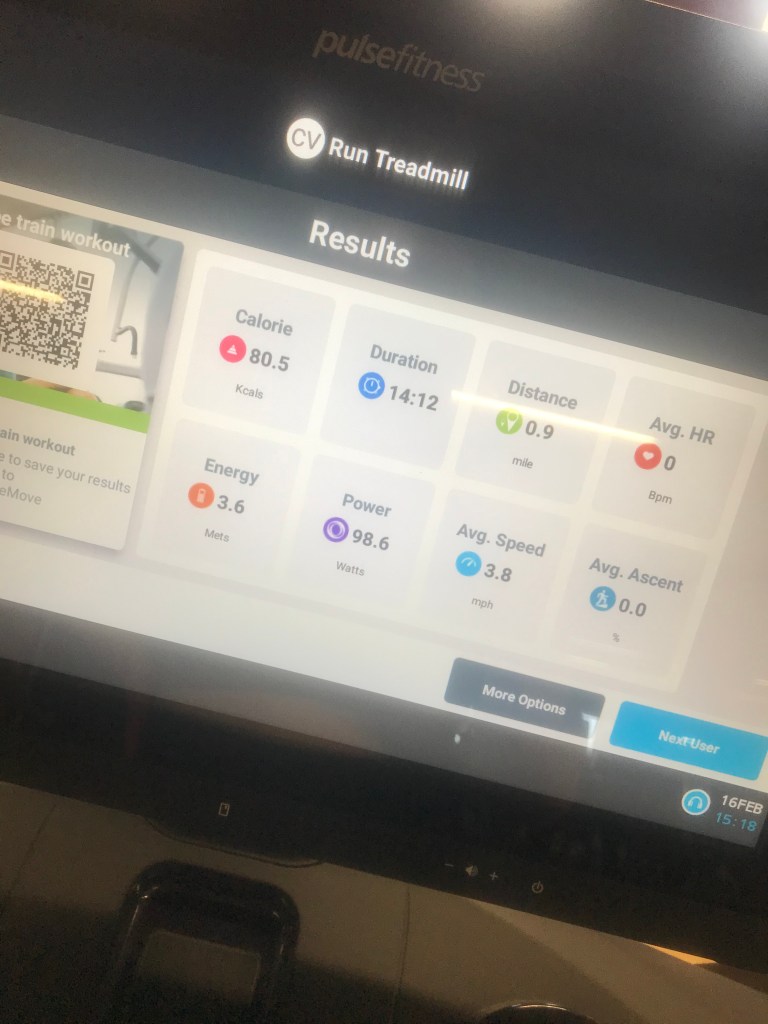
  • 16/02/20 – Cross-training session – 5.15k on the treadmill and 8k on the exercise bike
Strava log of the hill sprints session
Results from the 10k on the exercise bike
Results from the 5k on the elliptical

Having taken the time to reflect on what I’ve achieved over the past week, and actually refer back to my marathon training plan, I can confirm that all is not lost. Beating myself up about not getting out for a run isn’t going to get me anywhere and, according to a Runner’s World article I read recently, sometimes it is important to listen to your body when it’s crying out for a rest, because it most likely needs it.

Moving swiftly on, it is time to examine what I can do to ensure that the negativity I feel towards myself and my progress right now is mitigated by the establishment of behaviours that successfully result in getting out for a run.

On 03/02/20, we had a lecture with Dr Rhi Willmot where we learnt about the behavioural psychology behind training to run a marathon and the science of habit formation.

Lally and Gardner (2013) define habits as ‘automatic behavioural responses to environmental cues’ that develop through repeating a certain behaviour within a certain context. Put more simply, habits are a result of routine behaviours that follow cues and result in rewards. The use of rewards is essential to habit formation, as they act as positive reinforcers which increase the likelihood of a behaviour being repeated.

I am still very much in the early stages of creating my running habits, however some of my efforts thus far have proved to be successful. For example, completing my long slow run (LSR) on a Sunday:

  • CUE = Receiving a message from my friend confirming the time for our run
  • ROUTINE = Going on our run
  • REWARD = Sense of achievement for completing the run, plus knowing that I have the rest of the day to take it easy and do whatever I want

As my progress over the past week has shown, where I’ve struggled most is actually just putting shoes on and getting out for a run. This is perhaps due to the fact that I currently have fewer positive reinforcers for going on a run versus staying inside. In other words, I have been much happier staying well within my comfort zone instead of challenging myself to try and step outside of it.

Stanovich and West’s (2000) Dual Process Theory offers one possible explanation as to why I might be more inclined to stay inside and less inclined to go for a run. The theory posits that any thoughts that arise can be processed by one of two systems. The ‘hot’ system is described as being inflexible, automatic and requiring very little brain power meaning it often deals with more unconscious notions. The ‘cold’ system is described as being more rule-based, analytical and requiring a greater amount of brain power, meaning it deals with more conscious notions.

So, when I’ve thought about going for a run, there has been a battle between the two systems in my mind, and throughout the past week it is clear that the ‘hot’ system has prevailed over the ‘cold’ system. Staying inside has provided me with the instant gratification on which the ‘hot’ system thrives; the positive feeling generated by warmth, pain relief and food (and binge-watching Game of Thrones…eeek!) which has triumphed over the weaker ‘cold’ system that has urged delay of the gratifying positive feelings until I have completed a run.

Had I not been suffering with cramps, there may have been a slightly increased likelihood of the ‘cold’ system beating the ‘hot’ system. As time goes by, and marathon day gets closer, I will attempt to increase the role of the ‘cold’ system in my decision-making when it comes to running so that that in itself becomes a habit, in a sense.

In closing, my next blog post will be a reflection of my performance in the upcoming Anglesey Half Marathon on 01/03/20. Between now and then, I will continue to work on correcting my bad habits and get back into training with the enthusiasm of the first few weeks.

“We are what we repeatedly do. Excellence then is not an act but a habit”

Aristotle

References

Lally, P., & Gardner, B. (2013). Promoting habit formation. Health Psychology Review, 7(sup1), S137-S158. https://doi.org/10.1080/17437199.2011.603640

Stanovich, K. E., & West, R. F. (2000). Individual differences in reasoning: Implications for the rationality debate?. Behavioral and brain sciences, 23(5), 645-665. https://doi.org/10.1017/S0140525X00003435

Categories
Uncategorized

A bit more background, SMART goals, and small victories

In the run-up (*pun not intended*) to starting the Born to Run module, I had mixed feelings of excitement and apprehension. I was enthusiastic about the prospect of training to run a marathon, but I was also secretly dreading the competition that I’d constructed in my head between myself and the others doing the module, without even knowing most of them, let alone going on a run with them!

It was around mid-June last year that it occurred to me I would need to start running ASAP, but summer was fast-approaching and the UK was set to experience an intense heatwave the following month. Finding the motivation to get out and run in the increasingly hot weather was not something that came easily to me, being a lover of the cold.

Mid-way through summer, I was persuaded by a friend to run the Bangor 10K on 3rd October; I absent-mindedly signed up and almost immediately put the date of the race, along with any hopes of training to the back of my mind (which was my first rookie mistake). That was, of course, until the race was three weeks away, and I hadn’t even managed to put on some trainers and head outside! Needless to say, despite enjoying the race experience and being pleased with my 10K time all things considered, my newfound love for running was short-lived. I knew I needed to get out and start running in preparation for the module, but actually putting trainers to tarmac was a different matter entirely.

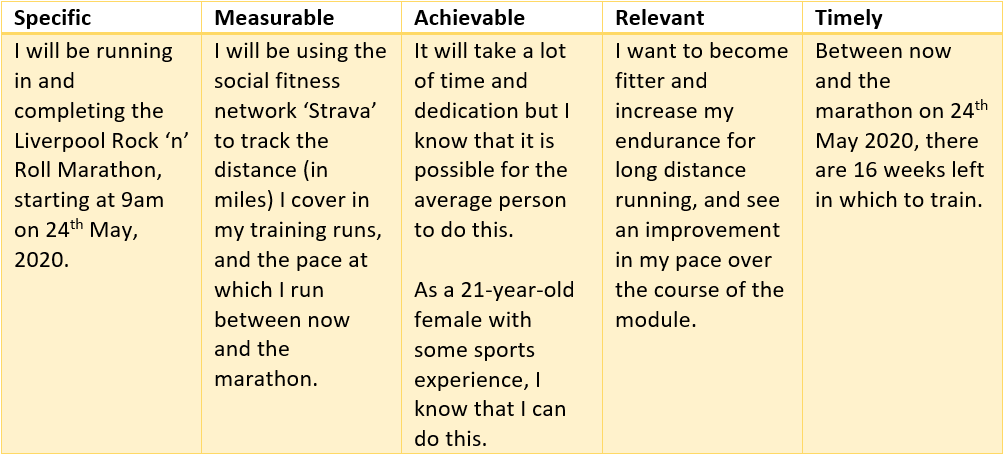
In the lecture on 27th January (week 2), we were introduced to the concept of SMART (specific, measurable, attainable, relevant, time-bound) goal setting, and how we can apply this framework to construct our ultimate goal (the big one, i.e. the marathon) as well as smaller goals. Below you will see the SMART breakdown of my ultimate goal:

The SMART breakdown of my ultimate goal: Running the Liverpool Marathon

Clearly defined goals that can be measured, are within reach and have a set deadline are more likely to be reached in comparison to goals that are vague and casual in nature. For example, a person who says “I will lose 1 stone by the 1st March this year” is much more likely to succeed in their weight loss than a person who simply says “I would like to lose weight”.

While I need to be constantly aware of my ultimate goal, having many smaller goals will ensure that I remain on track for success. If I successfully reach my smaller goals, and celebrate those small victories (which is an important thing to do, according to Amabile and Kramer, 2011), by way of positive reinforcement, I know I will eventually achieve what I set out to do from the very beginning.

From the first group run to the second, I saw an ever-so-slight increase in my pace and seeing this small improvement generated a feeling of pride and that itself became a positive reinforcer for me. Knowing that I have run just that little bit faster makes me eager to get outside and go for a run to see if I can do one better.

The group runs themselves have already proven beneficial for me, as I feel a lot more determined to run when I know others are running with me, compared to when I am running alone. There is plenty of research that shows my increased determination is not uncommon, as the presence of others alone tends to increase overall performance and this applies to many tasks, not just running.

As well as the group runs, I have also completed two long slow runs (LSRs) with a friend of mine who runs at a fairly similar pace to me. The first of these saw me complete my longest distance to date (6.87 miles / 11km) and the second saw another reinforcing increase in pace from the previous week. I believe that both of these small victories were brought about by the presence of my new running buddy, the benefits of whom are numerous.

On a closing note, I am feeling positive about the weeks of training that lie ahead. I know there are challenges I have yet to face, but by maintaining the positive mindset, keeping the ultimate goal in mind and celebrating my small victories, I can do this.

I am a marathoner, after all.

“When you continuously compete with others, you become bitter, but when you continuously compete with yourself, you become better”

Marie Blanchard

References

Amabile, T. M., & Kramer, S. J. (2011). The power of small wins. Harvard Business Review89(5), 70-80.

Bjerke, M. B., & Renger, R. (2017). Being smart about writing SMART objectives. Evaluation and program planning, 61, 125-127.

Carnes, A. J., & Mahoney, S. E. (2016). Cohesion is Associated with Perceived Exertion and Enjoyment during Group Running. Journal of Exercise Physiology Online, 19(6).

Categories
Uncategorized

Introduction

Hello everyone and welcome to my blog!

My name is Aoife and I’m a 3rd year Psychology student at Bangor University, North Wales. As part of my final semester in university, I am taking part in a module called ‘Born to Run’ in which I will apply principles of motivational and positive psychology to training for, and eventually running, a marathon. This is a big challenge for me as I am not an experienced runner by any means, but it has always been something I’ve wanted to get into. It’s going to be tough, but I am ready for the challenge!

I have created this blog in order to document my journey towards being able to run the Anglesey Half Marathon at the beginning of March, and the Liverpool Rock ‘n’ Roll Marathon at the end of May this year. I will be writing about all the ups and downs of my running adventures and tracking my progress along the way.

I hope you stick around to follow my journey from being a novice short-distance runner to a *mildly* experienced long-distance runner!

Design a site like this with WordPress.com
Get started