In my last blog, I spoke a lot about the final long run I went on before the Anglesey Half Marathon. I’m about to let you in on a little secret… it was also the last run I went on before the race (oops!). So, in terms of physical preparation in the week before, I did very little. But I don’t plan on dwelling on that too much, it is something I’ve already learnt from, and believe me when I tell you, I’ve paid the price for my mistake!
Without further ado, I believe I promised a low-down of what happened on the day of the race:
6:30am – waking up – I am NOT a morning person, so waking up early doesn’t usually come easily to me, however the nerves drove me out of bed faster than the Roadrunner whizzing past Wile E. Coyote on the Looney Tunes!
7:00am – breakfast – I opted for a breakfast of two Weetabix and a coffee (although my choice of beverage would very soon become mistake numero dos!)
7:45am – time to leave – I triple checked my bag to make sure I had everything I needed (race number, phone, arm strap, warm clothes for afterwards – check, check, check and check!)
8:15am – arriving at the start line – it was around this time that I realised my decision to have a coffee so close to the start of the race was a big mistake – I have never needed to go to the loo so many times within such a short period in my life! As crowds continued to gather, my nerves began to increase.
8:45am – getting in position – people were beginning to make their way over to the official start line – it was at this point that my housemate and I met some fellow ‘Born to Run-ers’ – the camaraderie and support was definitely reassuring in the final few minutes before we set off
9:00am – GO! – the ‘3…2…1…’ countdown had ended and we were off!
In those first few minutes, I went through several emotions, and at one point was close to tears – I didn’t think I could do it – the prospect of running for the next few hours terrified me – I’d never run 13.1 miles before in my life!
From this point onwards, the concept of time became irrelevant to me, I had no set time goal in mind (apart from making the cut off at the 10-mile mark, around 11:15am). Luckily, I managed to find a running buddy from the module and we kept relatively the same pace for several miles, chatting about how we’d spent our reading week.
This meant that I was using the dissociative attentional strategy instead of the associative that I’d originally planned to use, which I discussed in my last post. Talking to my newfound running buddy helped distract me from wondering how far we had run and made those first few miles a great deal easier.
As we approached Beaumaris, running down what we came to know as our worst nightmare (AKA: Allt Goch Bach), we began to see the front-runners making their return, with many of them telling us to “enjoy the downhill!”. This not-so-helpful remark clarified the realisation that we would have to run (and I use the word “run” very, very loosely here) back up this monstrosity.
With that cheery thought in mind, we pressed on through Beaumaris, passing more and more runners and exchanging several words of encouragement. I must admit, one thing I do enjoy about being in a race is how supportive everyone is, and although you don’t have a clue who they are, you find yourself wishing them well, and in turn they do the same.
There is something about the experience of being in a race that makes it vastly different to a normal individual training run. Whilst running in the half marathon, I found myself being able to keep going for longer which indicated to me that I was performing better than I usually would on a training run.
This phenomenon of increased performance during a race is not only common sense, it is also well-documented in the literature:
A study by Tomazini, Pasqua, Damasceno, Silva-Cavalcante, de Oliveira, Lima-Silva and Bertuzzi (2015) found that running in a race gave rise to changes in the performance of recreational runners compared to running alone. Their findings showed that the runners’ overall performance was better in the race condition compared to the individual condition.
However, Tomazini et al’s (2015) research only looked at runner’s completing a 3km race, so the extent to which their findings can be applied to a half marathon race is limited due to the fact that it is, of course, 7 times the distance.
That being said, back in October 2019, I completed the Bangor 10k (my first ever race) and to date, the time I ran that distance in is still my PB!
As we came out the other side of Beaumaris, I gradually ran ahead of my partner, and when I kept looking back to check on them, they seemed to be getting further and further away. When I turned a corner and could no longer see anyone behind me, I realised that from this point onwards I would be going it alone.
My goal remained unchanged: I had to make the cut-off so I could keep going and finish the race, otherwise I’d feel like a complete failure.
At this point, I knew we had to be approaching the halfway mark. The route was due to loop back round at some point, but it kept taking me up and up into the countryside, and it felt like a lifetime had passed by the time I eventually crossed the chip tracker at the 10K mark and the road began to bend back round in the direction of Beaumaris.
Slowly plodding along, I noticed another ‘Born to Run-er’ up ahead and decided to quicken my pace slightly in order to catch up to them. We managed to stick with each other for a little while and, in this time, I came up with a positive thought that would eventually become the only thing keeping me going when I found myself alone again slightly later on.
Being one of the slowest runners in a group of people actually has a perk: the longer you take to finish a race, the more people there are to cheer you on at the end (provided people hang around afterwards until the final person crosses the finish line, which quite a few tend to do). I knew this would be the case for me, as several friends were also taking part in the race, and we’d already made plans to go for a meal in Menai Bridge straight after finishing the race.
The run back into Beaumaris was probably one of the most physically challenging parts of the race as the wind was very strongly against me. It was also at this point that the race began to get very psychologically challenging.
It was then that I began to visualise myself sprinting across the finish line, as all my friends looked and cheered me on.
Research conducted by Samson, Simpson, Kamphoff and Langlier (2018) on the thought processes of long distance runners revealed that many engaged in visualisation as a strategy to enable them to maintain their pace.
Use of the ‘think-aloud’ technique, where the runners’ were asked to verbalise their thoughts during a long-distance run, enabled the researchers to measure runners’ thought processes in real time. This was done by giving each of the runners’ a microphone and recording device to take with them and speak into whilst they were out on their run.
Although Samson, Simpson, Kamphoff and Langlier’s (2018) research provided a useful insight into the different techniques runners’ use for managing their pace, the ecological validity of their study can be questioned, as it is unlikely that I would verbalise my thoughts whilst out on a run in public, as I may get some odd looks from strangers.
In terms of applying this to my own experience, while I didn’t use visualisation to maintain my pace as such, it definitely made me speed up in order to see it unfold in reality.
Therefore, when it comes to running the marathon in May, using visualisation will be crucial for me to keep pushing on in those final few miles.
If you had told me a year ago that I would complete the Anglesey Half Marathon, I would never have believed you! While the course was incredibly tough, and the pain unbearable, I did it (GO ME!).
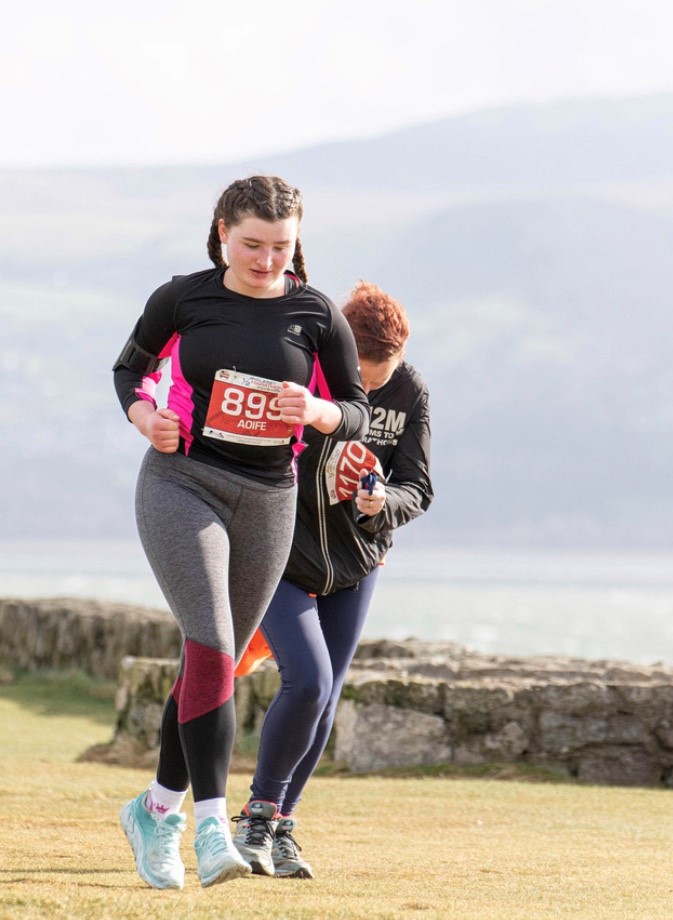
Thanks to modern technology, there is recorded footage of the moment my visualisation became a reality (skip to 2:56:24).
The satisfying post-race high left me with a hunger to improve. In a moment of impulsivity, along with some encouragement from friends, I signed up for the Reading Half Marathon on 5th April.
This is likely to be a very different experience as I will be running much closer to home, meaning that my family and boyfriend will be able to come and watch me run for the first time. In addition, the route is meant to be very fast and flat, so I am looking to see an improvement upon my Anglesey time, which will hopefully provide a much-needed confidence boost to spur me on in my training and maintain the sense of enthusiasm that will enable me to keep up my running to the end of the module and beyond.
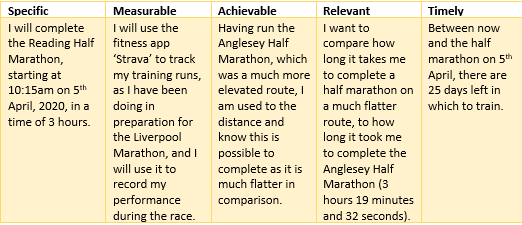
With all this considered, time for another SMART goal:
“Run when you can, walk if you have to, crawl if you must; just never give up.”
Dean Karnazes
References
Masters, K. S., & Ogles, B. M. (1998). Associative and dissociative cognitive strategies in exercise and running: 20 years later, what do we know?. The Sport Psychologist, 12(3), 253-270.
Samson, A., Simpson, D., Kamphoff, C., & Langlier, A. (2017). Think aloud: An examination of distance runners’ thought processes. International Journal of Sport and Exercise Psychology, 15(2), 176-189. https://doi.org/10.1080/1612197X.2015.1069877
Tomazini, F., Pasqua, L. A., Damasceno, M. V., Silva-Cavalcante, M. D., de Oliveira, F. R., Lima-Silva, A. E., & Bertuzzi, R. (2015). Head-to-head running race simulation alters pacing strategy, performance, and mood state. Physiology & behavior, 149, 39-44. https://doi.org/10.1016/j.physbeh.2015.05.021

 First Time Marathoner